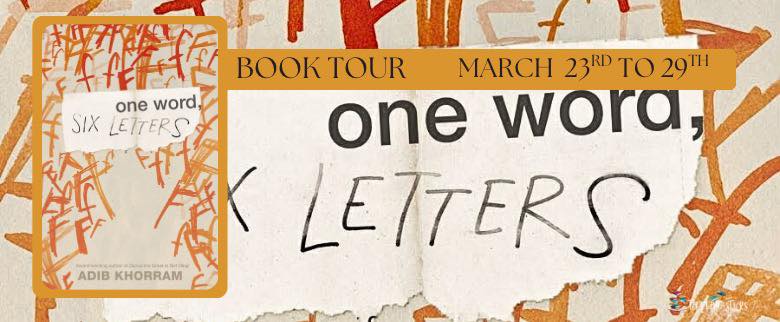
Blog Tour & Author Interview: One Word, Six Letters by Adib Khorram
We’ve been following Adib Khorram’s work since Darius the Great Is Not Okay, and watching him build a body of work that consistently makes space for readers who don’t often see themselves on the page. His newest novel, One Word, Six Letters, follows Farshid, a Persian, queer fourteen-year-old navigating spaces that weren’t built for him, and the questions it asks about community, accountability, and grace feel urgent in a way that is hard to ignore right now.
We sat down with Adib to talk about what it means to release this book in this moment, the shifting landscape of YA publishing, what he put of himself into Farshid, and who he most hopes finds this story. Check out our interview below and pick up One Word, Six Letters, out now!
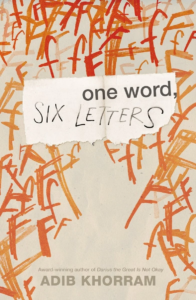
One Word, Six Letters
by Adib KhorramPublished by: Henry Holt & Co. (BYR)
on March 17, 2026
Bookshop
Goodreads
Two teen boys grapple with identity and accountability and set off a ripple effect within their community after a school assembly is disrupted by a shouted slur.
Freshmen Dayton and Farshid couldn’t be more different—or so it seems.
When Dayton takes a dare and shouts the f-slur at a visiting author during a school event, it sets off a chain reaction that forces both boys to face parts of themselves they’d rather ignore.
Dayton, grappling with the fallout of his actions, faces rejection from his friends, disappointment from his parents, and a growing awareness of the harm he’s caused. Meanwhile, Farshid is left to untangle his own feelings—about himself and about the quiet struggle of coming to terms with his queerness in a world steeped in heteronormativity.
As their lives unexpectedly intersect, Dayton and Farshid must reckon with what kind of men they want to become and whether they have the courage to defy toxic masculinity and societal expectations.
Timely, raw, and deeply thought-provoking, this novel is perfect for fans of Jason Reynolds and Nic Stone.
Interview with Adib Khorram
We’ve been with you since Darius, for every story through the age groups. We’ve watched you build something in a market that doesn’t always make that easy. What does it mean to you to release this one right now?
It’s a little surreal, to be honest. I started writing One Word, Six Letters in May 2024, and it was substantially finished before the election that year. It’s strange to think that its themes may be even more relevant than I had anticipated, while at the same time, it’s coming out in an environment that’s more hostile than I would have hoped.
I’m not usually one to say (or think) things like this, but…this book feels important and necessary. So I guess it feels like my way of trying to put some good into the world when it feels like there’s a severe lack of it.
You’ve been loud and consistent about book bans through Authors Against Book Bans, which we respect deeply. But I want to ask you something more personal: what does it cost you, as a queer Persian man, to keep showing up in this fight while also just trying to put your books into the world?
Part of me wants to say that it costs me nothing. That I’m fighting this fight because it’s necessary, because I have skills that dovetail with others’ skills that together make the fight easier for us all. And that there’s no point putting books out into the world if no one will be able to read them because they’re banned.
The other part of me is just so exhausted. Fighting book bans feels like playing whack-a-mole. As soon as you deal with one crisis, another pops up. And it takes a toll emotionally. I don’t think I know a single author of children’s literature who doesn’t want to make the world a better place for young people everywhere; to have people telling us we’re harming the very people we’re in service of—to be called groomers or worse—takes its toll.
The YA market is changing in ways that genuinely scare us. Queer authors moving to adult, acquisitions getting safer and whiter and straighter. You’ve been in this space long enough to feel that shift. What do you think is actually happening, and what do we lose if it keeps going?
I think there are a number of forces at play here—some cyclical and some fairly new.
It’s been my experience that YA literature goes through a cycle where it trends older and older, which I associate with a readership cohort aging up, holding onto YA a bit too long before branching out into new kinds of literature, after which YA ages down again. I think we’ve held onto this older YA a little too long, and we need a rebalancing.
That has been compounded by algorithmically-driven companies like TikTok, which thanks to the sales they generate, have outsized influence on the shape of the market. TikTok made lots of folks who weren’t readers before into readers, which is terrific, but those new readers—most of them not actual teenagers—come with expectations of YA literature that are at odds with its mission. Any time someone asks if a YA is “spicy” I want to vomit. YA is about and for teenagers, and depictions of sex in YA need to center their emotional and developmental needs—not the desires of adults who want to be titillated.
And of course, as you mentioned above, book banning (and soft censorship) have shifted the landscape of the young adult market. Schools and libraries have less and less purchasing power, and stories by and about marginalized communities face more and larger challenges.
That’s not even getting into diminishing attention spans, the lingering effects of the pandemic on students, and all the struggles teachers and librarians face that I’m not privy to. Sometimes it feels like YA is under siege from all directions! And it’s young people who are most harmed by this. People sometimes forget that young people don’t stay young forever, and we’re not fostering future literary citizens when we exclude huge swaths of readers from stories that resonate with their lives.
Farshid feels specific in a way that matters. Persian, queer, trying to exist in spaces that weren’t built for him. How much of yourself is in him, and what did you decide to trust readers to carry without you explaining it to them?
I like to say that every book is a book of my heart—if my heart’s not in it, why write it?—but this one does feel like I put more of myself into it. Probably the tenderest parts of me since Darius the Great Is Not Okay. Farshid got a lot of pieces of my upbringing, being Bahá’í, being the lone Iranian at school, his struggles with body image. But at the end of the day, he’s still not me. I think the biggest leap of faith I took was that folks would understand why he’s such a jerk to his mom. He’s not the only fourteen year old with a lot of fear and anger and no idea where to put it, but that still doesn’t make it comfortable to sit with him through it.
There’s something this book is doing around masculinity and permission and what boys are allowed to become. As a man writing both of these boys, what were you working through?
To be honest, I think the seed at the heart of this book—the deepest question it has—is not about masculinity. It’s about community. It’s about what the difference is between punishment and justice. It’s about how we make amends when we’ve harmed others, and how, if we’re harmed, we choose to heal ourselves and the world around us. It’s about when (and how) to extend grace, whether it’s earned or not. It’s about being empathetic. To paraphrase Ted Lasso, it’s about being curious, not judgmental.
Examining masculinity ended up being the lens I used to ask those questions.
Who do you most want holding this book right now?
Anyone who’s convinced themselves they’re irredeemable just because they made a mistake. There are so many young people I talk to these days who are afraid to make any mistakes, who think being wrong makes you bad. I hope it encourages people to give grace to themselves and the people around them.
Follow the Tour
March 23rd
Bookcrushin – Interview <– You Are Here
Ilovebooksandstuffblog – Promotional Post
March 24th
The Brave Bookshelf with Kim Bartosch – Top 5 Reasons to Read One Word, Six Letters
Boys’ Mom Reads! – Promotional Post
March 25th
unconventionalquirkybibliophile – Promotional Post
The Clever Reader – Promotional Post
March 26th
Confessions of a YA Reader – Promotional Post
The Book Dutchesses – Promotional Post
March 27th
Mx. Phoebe’s Viewpoint – Review, Favorite Quotes
March 28th
The violet west – Promotional Post
March 29th
Never Hollowed By The Stare – Promotional Post

Leave a Reply