Author Interview: Absent by Rex Ogle
Rex writes from his own life, from poverty and domestic violence and food insecurity and the experience of being a kid that a system let’s slip through the crack (or worse, blames them for it), and keeps coming back to the hurt and the challenge because the kids who are living those circumstances right now need to know someone sees them. Free Lunch was the book that cracked him open publicly. The Four Eyes series, which we devoured this summer and gave five stars across the board, took that same honesty to even younger readers. Absent, out September 1st, is him going bigger: three boys, three formats, one braided story about what absenteeism actually looks like from the inside. We had some questions and Rex was gracious enough to answer them! Check it out below and pick up Absent for yourself and all of the young readers in your life!
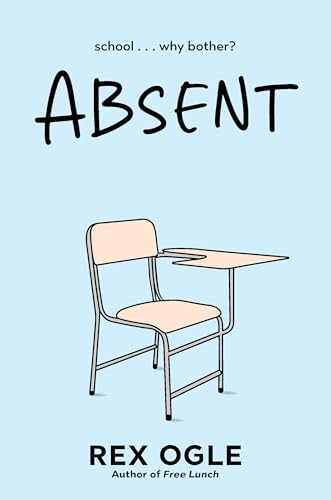
Absent
by Rex Ogle, LJ BaptistePublished by: Norton Young Readers
on September 1, 2026
Genres: Contemporary, Middle Grade
Bookshop
Goodreads
From award-winning author Rex Ogle, a mixed-format middle grade novel about three boys who skip school, told in verse, prose, and comics.
With a dad in jail and a lack of teachers interested in helping him learn, Manny doesn’t see the point in anything besides skateboarding and writing lyrics. Calvin has so many responsibilities to his father and little brothers that when his bike is stolen, he can’t make it to school on time. And while Liam is studious and wants to become a doctor, he is tormented by bullies and hides out in an unused janitor’s closet instead of going to class. When the boys are thrown together in detention, they realize that they might still have a lot to learn—not just from their teachers, but from each other.
Absent tells the boys’ stories in three distinct Manny’s in verse, Calvin’s as a comic, and Liam’s as a prose journal. Printz Award Honoree and YALSA Nonfiction Award winn
Interview with Rex Ogle
You went to teachers and librarians first when you were developing this book and absenteeism kept coming up as the biggest thing they were seeing. What surprised you most about what they told you, and how did those conversations change the story you thought you were going to write?
I spent my childhood being embarrassed and ashamed of my circumstances. Among them, poverty, domestic violence, food insecurity, and absenteeism due to babysitting my baby brother while my parents looked for work. As a writer, I want to normalize the struggles that kids living below the poverty line deal with on a regular basis. So when I began to speak to educators a few years ago, I was more than a little shocked to find out these were still huge problems, and getting worse. Librarians in Texas educated me on a state policy that for every kid not in first period, money is taken away from the school’s budget. In California, teachers explained that a massive amount of Hispanic families have stopped prioritizing education since COVID. And in New York state, a good friend and librarian shared how so many students fall through the cracks of a system that is more focused on test scores than on giving children real-world skills.
All these conversations made me realize that the novella I wanted to write about one boy, based on my younger self, would be far more impactful if it was bigger than just me. So rather than one protagonist, I opted for three. And while I was at it, I wanted to make the story accessible for more kids than just prose readers. The educators were more than helpful by telling me how much students love graphic novels and are starting to appreciate novels in verse for their brevity. From there, it all came together and made Absent what it is. This book would not exist without so many educators wanting to make a difference in the lives of the next generation.
Each boy gets his own format because you wanted to meet readers where they are rather than asking them to come to you. Did the format ever push back on the story, where Manny’s verse or Calvin’s comics took you somewhere the prose version of that character would not have gone?
Oh, 100%. While I’ve written prose and comics and in verse, I’ve never attempted all three in a single story. Luckily, each character was so unique and so different from the next that their stories shined through each format. Calvin, who wants to be an artist, was so clearly into drawing comics to share his life. Liam, who wants to be a doctor, decided to chronicle his life in a prose journal to track all of his personal discoveries and research into ailments around him. And Manny, oh Manny, he was the first kid in my head and so clearly needed his story to be in verse, to show his love for an incarcerated father who is not a bad person but yet another victim of a society that fails those who have the least.
The biggest challenge was not the characters and their respective storylines. It was braiding the three narratives into a single, cohesive storyline. It was creative gymnastics in my head, teaching myself to look at the stories in a different way than I had previous stories. I wrote the whole thing in one fell swoop, and then went back and edited and revised the stories one at a time. What I discovered, and then reinforced, was that a reader can choose just one of the stories to follow and each format tells its own story. A reader does not have to read all three. They can choose just one, as long as they read the notes passed back and forth between all three boys in detention.
But it is not just the words that matter in Absent, but the visual cues that differentiate them. Graph paper and softer handwriting for Liam. A blank sketchpad to fill with art and ideas for Calvin. And a simple lined notebook for Manny, whose words and phrasing needed to be concise for the rough and tough kid who does not speak but has a whole world of thoughts inside that he struggles to express.
Free Lunch has been part of almost everything you have written since, even when it is not the subject. Where does Absent sit in relation to that book for you, and what does it feel like to keep returning to the kids who slip through the cracks when you were once one of them?
I have wanted to be a story creator since I was five. When my parents would fight and scream, I would lock myself in my bedroom and escape into the worlds of Dr. Seuss and Chronicles of Narnia and then of course the X-Men. Anyone who knows me knows I am obsessed with Claremont’s run. So when I started writing, I followed suit. I wrote fantasy and horror and sci-fi, because that is what I loved, that is what helped me escape the trauma that surrounded me in our trailer parks and government subsidized housing. But after writing 18 novels and 21 comic book series, all of them rejected, I decided to try something different. To write about my own experiences. It is not something I wanted to do. It is something the universe led me to, as if this was always the place I was supposed to arrive at.
Now, my pain is my platform. I am not the only youth who has been affected by the struggles of those at the bottom of the social hierarchy. Millions of kids in our country are forced to endure and battle against hunger and violence and sexual assault and homelessness. That is the real world. And though I still want to write stories to escape, I find it necessary to spend half my time and resources creating stories that console kids who have become the victims of capitalism and let them know they are not alone, provide truth to those who have no idea what is occurring all around them and give them starting points for empathy, and offer shortcuts to every youth, shortcuts that took me years and sometimes decades to learn, in the hopes that it will aid kids in navigating a world that is stacked against them.