
Author Interview: Night of Madness by Ryan Douglass
Mara is a horror fan whose only fond memories of her dad involve his favorite filmmaker, Jack Stanley, and when Stanley announces a contest sending five teen influencers to spend the night on the set of his most terrifying film, Mara engineers her way onto the roster. What follows is part social media satire, part slasher, and part reckoning with what you find out about yourself when survival is the only option.
To prepare for Night of Madness, out September 29th, we asked Ryan Douglass some questions!
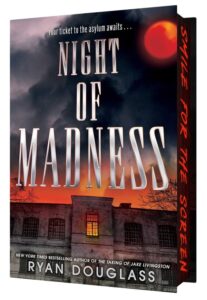
Night of Madness
by Ryan DouglassPublished by: Simon Pulse
on September 29, 2026
Bookshop
Goodreads
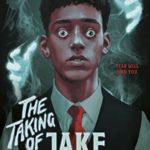
Teen influencers compete in a horror movie–themed overnight competition, only to realize the real test is staying alive in this chilling, blood-soaked horror novel from the New York Times bestselling author of The Taking of Jake Livingston and the production company behind Clown in a Cornfield.
Mara is a horror buff whose only fond memories of her dad are bonding over movies by Jack Stanley—the producer of the eighties. Stanley’s campy slasher movies may have kept Mara’s fraught parental relationship on life support and gained a cult following, but the man himself has faded from the public eye…until he announces a contest centered around Asylum, his most terrifying film. Five teen influencers will be invited to spend the night on the fully constructed set; whoever sticks it out until morning wins a hundred thousand dollars.
Stuck in a dead-end job, Mara seriously needs that cash. She may not be a famous influencer, but there has to be a way to manufacture an online presence that will capture Stanley’s attention. With the help of her brother and best friend, Mara finds some creative solutions to her dilemma and lands herself onto the roster of the lucky chosen few by way of her engaging authenticity.
When Mara and the other contestants arrive on set, it’s a horror fan’s dream being immersed in the asylum setting, but as the night wears on, they realize the danger is more than movie magic… They’re not there to win or lose but to live or die. As Mara fights to survive, she discovers an inner ruthlessness she didn’t know she had.
Interview with Ryan Douglass
Mara gets onto the roster by crafting an online presence with help from her brother and best friend, but the book describes it as winning Jack Stanley’s attention through her “engaging authenticity.” That tension between performed authenticity and actual authenticity is basically the entire economy of influencer culture right now. Was that contradiction intentional, and what did you want readers to sit with about what authenticity even means when everything is content?
I think what we show online is influenced by what we think others want from us, so there is always a certain level of performance. The mess that comes with being human is mostly popular when it’s funny or entertaining, so vulnerability is not always encouraged, and authenticity requires that. So, I do think there’s a difference between who we are and what we give to social media, which is just an extension of the entertainment economy. The toxic side is that because we’re comparing lifestyles and social status it makes us think we have to do things to earn popularity or the feeling of being enough. The first act of this book sees Mara trying to make her online persona bigger, more enticing, and more performative because it will give her value in the competition. It leads her to wonder if she’s becoming more herself or a version of herself that’s rewarded by strangers who just want to be entertained. I mainly want readers to think about why we put so much weight into the opinions of strangers, when they have little power over how fulfilled we actually are.
Jack Stanley is a relic of a very specific era of horror, the campy eighties slasher, and his movies are the emotional thread connecting Mara to her father. Horror nostalgia has had a massive cultural moment. What is it about a particular era of horror that keeps pulling us back, and what does it mean that the thing Mara loves most about her dad is also the thing that puts her in danger?
I think the ’80s delivered such strong trailblazers because the decades before it had a more socially restrained approach to horror. The unhinged energy of something like Child’s Play wasn’t being matched by a lot of mainstream horror that came before it and it works so well because it pushes against cultural limits. A lot of what we’re seeing now is the horror that feels grounded in realism and the stuff that plays on social fears. Night of Madness kind of bridges those two styles. It pays homage to the campy eras and has a colorful, retro vibe that pulls you into a different time, and it feels nostalgic, but the social aspects are very here and now. For Mara, horror is one of the last places she still feels connected to her dad. Those movies formed a bond between them, so she clings to them because they’re tied to happy memories from her childhood and what life was like before he left them. It feels inevitable that as long as she holds on to idealism associated with her dad, or who he was before he left, her interest will always be piqued by Jack Stanley, and what he represents.
You say your work explores the ways young people fight to survive in hostile worlds. Night of Madness is pretty literal about that, but the inner ruthlessness Mara discovers in herself is framed as something she did not know she had. What did you want readers to feel about that discovery, and is finding out you are capable of doing whatever it takes to survive something to celebrate or something to grieve?
That discovery feels true to life to me, so I hope readers will see themselves in it. Good people have to learn how to resist evil, or else surrender to villains so it’s about developing the strengths you need to survive. Mara wrestles with how hard she’s willing to fight for what she cares about, and what she’s willing to sacrifice for what she’s fighting for. I think it’s worth celebrating the fact that the game isn’t able to break her and that she’s a final girl. But there’s grief in the journey, because she has to develop darker parts of herself to make it through. So, I hope readers come away feeling seen in both truths: relief that she endures, and sadness that survival requires her to lose some innocence along the way. I think this reflects the bittersweet reality of growing up.

Leave a Reply