
Author Interview & Giveaway: Rising Thunder by Neal Shusterman
Neal Shusterman is an author we have been following for a long time, and when we got the chance to sit down with him again after our conversation about All Better Now, we jumped at it. Rising Thunder is the first book in a new prequel trilogy set in the world of the Scythe series, out December 1st and it is going back to the beginning of the Thunderhead before it became the entity that defined an entire trilogy, and placing that origin squarely in the AI conversation we are all living through right now. Read on for Neal’s thoughts!
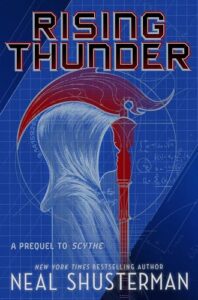
Rising Thunder (First Blades, #1)
by Neal ShustermanPublished by: Simon & Schuster Books for Young Readers
on December 1, 2026
Bookshop
Goodreads
Discover Thunderhead’s origin—the fragile moment before the world changes forever and the hidden forces that set the storm in motion—in this long-awaited prequel to the New York Times bestselling and Printz Honor–winning Arc of a Scythe series by Neal Shusterman.
And of course, as every school child knows, December 2042 marks the end of the Age of Mortality.
What no one has ever fully understood is how the world reached that moment.
As death begins to seem optional, humanity looks for ways to bend the rules of existence. Twi-life centers begin storing the nearly-deceased, while eco-nihilists destroy civilization’s icons and threaten to end the human race entirely. Public opinion fractures. Systems strain. The world feels…unstable.
Behind the scenes, two powerful and diametrically opposed artificial intelligences set out to optimize, stabilize, and protect—each with its own idea of what that means. But in a world already tipping toward transformation, the consequences could be catastrophic.
Meanwhile, in an obscure online chatroom, a small group of teenagers from around the globe debate both the glorious and the terrifying prospects of the future, never realizing that they stand on a very literal cutting edge—and that their conversations, their choices, their very existence matter far more than they realize.
Because when humanity stands on the brink of immortality, someone must decide what survives…and what must be cut away.
Interview with Neal Shusterman
The Thunderhead is terrifying specifically because it is not a villain. It loves humanity and it is still the most dangerous thing in the room, at least to some of us. Rising Thunder gives you the Thunderhead before it settled into that. What did writing its origin require you to figure out about how it got there?
I actually don’t find the Thunderhead terrifying—because it’s a positive end-product that managed to defeat, and transcend all the bad versions of AI that we fear. The Thunderhead is beyond the storm. I find it comforting to imagine that a place beyond the AI storm might someday exist. But Rising Thunder takes place right within the maelstrom—a maelstrom that we’ve already sailed into. That’s why I felt it so important to show how the Thunderhead became what it became; because Rising Thunder is about our world, and what’s happening now, not the far-flung future. The Overcast (which is the nascent Thunderhead, not all that different from our current large language models) is still capable of error, and is subject to a digital Darwinism taking place behind the scenes that could leave humanity at AI’s mercy, if things go the wrong way. I find that terrifying.
You said after The Toll that there was a time to put the paintbrush down. What pulled you back in?
Well, I put one paintbrush down, and picked up another. I do not want to push the story beyond the end of The Toll. In Gleanings, I did some teasing as to where some characters might be, but by and large, The Toll concludes the story—however that didn’t stop me from being fascinated by how that world came to be. When world-building you create a basic mythology of how the world is. In this case, it’s extrapolating forward from our world. I wanted to paint that transition as realistically as I could. There were two ideas that I really wanted to explore. First was how our AIs evolved into the Thunderhead. Secondly, I had set up the idea of founding scythes. Who were they? How did they go from being ordinary people to these larger-than-life iconic figures? Then I realized that they were all probably teenagers who met on social media. I wanted to witness that, and see how it happened!
You built this world before AI became the conversation it is now. Going back into it in 2026, does it feel different to be writing it?
I feel there’s even more gravity to what I’m writing now, and more responsibility to do good, rather than harm. Science fiction is rapidly becoming reality—especially in the field of artificial intelligence. All the more reason to paint pathways out of the terror, because if all we have are stories showing us all the things that can go wrong, how can we ever get it right? AI is not going away. It’s up to us to imagine the versions of AI that assist us rather than defeat us; that inspire us rather than stultify us. Because if all we can envision is doom, then doom will be our inheritance.





Leave a Reply