Author Interview: Where You’ll Find Us by Jude St. Jude
There are books that feel like they were written for exactly this moment, and Where You’ll Find Us by Jude St. Jude is one of them. Cal is a trans teen who stumbles upon a place called Amaranth, a farmhouse outside of time where queer kids from across decades have found refuge, and the questions the book asks from there are ones that feel impossible to look away from right now: what gets lost when queer history disappears, and what does it mean to keep finding each other anyway. We caught up with Jude to dive into Where You’ll Find Us, out this week!
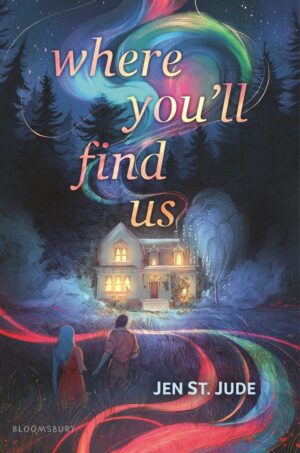
Where You'll Find Us
by Jen St. Jude, Jude St. JudePublished by: Bloomsbury YA
on June 2, 2026
Genres: Fantasy, LGBTQIA+, Young Adult
Bookshop
Goodreads
Calla Quick has no future. At least, that’s how it feels. Her parents disowned her via text message, and now she can’t afford to go to an all-women’s college with her girlfriend Ramona like they planned. But Calla wonders if maybe that’s for the best—because even though Calla told Ramona her parents disowned her because they found out she’s gay, the truth is, Calla has been questioning whether she’s a girl at all.
Calla wishes she had more time to figure everything out, and one night, her wish is seemingly granted. When Calla and Ramona stumble upon a mysterious farmhouse in the woods, they meet five teens who claim they’ve lived there for decades. The land, which they call Amaranth, acts as a safe haven for queer kids throughout history—a place free of hate, free of violence, free of time itself. Here, Calla can be Cal, and they feel instantly accepted. They don’t have to worry about the future because at Amaranth, it will never come—until one night when the clock strikes twelve.
Now under a literal ticking clock, the housemates must find a way to stop time again or face going back to their harsh realities, but as Cal learns everyone’s story, they begin to wonder what queer people lose when their history is lost to time.
Interview with Jude
Amaranth pulls queer kids from across decades with very different realities. How did you make sure each of them felt specific to their own time rather than just a version of the same experience? What was research like for you?
I built the cast to highlight a few pivotal times in queer United States history, and then worked to make each character feel like a singular, real person. Sunny is from the late 1920s, when ideology and terminology was shifting from “inverts” to “homosexuals.” Kiyo is from the 1940s, when the military thrust LGBTQ+ identities into a new cultural spotlight by creating exclusionary policies which defined and labeled behavior. Abe is from the 1950s, when organizations like The Mattachine Society and Daughters of Bilitis emerged, alongside The Lavender Scare and the rise of conservative mentalities about family, marriage, and values. Lionel and Ambrosia are from the 1990s when the internet and pop culture made queer people more visible and public than ever before, and when, of course, the AIDS crisis continued to change queer communities forever. I also wanted to make sure there were other layers to the characters outside of the moment they lived in. What families and communities did they come from? What were they passionate about? What did love mean to them? How could Ramona and Cal, the characters from 2026, relate to them? I wanted to show that all of these characters were just kids, too. They were real as any of us.
The research was fun and life-changing, and it was something I’d been already doing for so long just as a special interest. As a kid, I dreamed of writing historical fiction, majored in history in college, and carried that interest into my 20s and 30s. Queer history became especially important to me when I was figuring out my own identity. But what I’ve learned from historian and author Hugh Ryan is that most of the records we have that even mark our existence at all are from our interactions with police and law, or in medical capacities. And even when the internet emerged in the 90s to give us more of a voice, our communities were in the same moment being devastated by the AIDS epidemic. We have such a beautiful history, but our access to it is so limited because of the ways people have had to hide their lives, and because our identities are inconvenient to people interested in upholding white supremacy and the patriarchy. So initially I felt overwhelmed by the task of creating characters that were historically accurate and diverse. How could I find, on a deadline no less, how different people from different communities, places, and times might talk or think about themselves? How would others think about them? It felt daunting, and I cared so much about getting it right. My solution was to ask Hugh if I could pick his brain, and he so generously said yes. I expected him to maybe just give me tips on primary sources or his research techniques. Instead, he talked through each character with me. I really don’t know how I would have written this book without him. I’m so grateful.
Cal is still figuring themselves out while keeping a secret from the person they’re closest to. How did you write that particular kind of loneliness without making Ramona feel like an obstacle?
When we change as individuals in any kind of partnership, the relationship might change too. The stakes often feel highest in a romantic relationship because we pin our hopes and dreams for our lives on each other. But we’re still human, and individuals, and sometimes no matter how much we love each other, we can’t fully show up without abandoning important pieces of our own hearts. I expect some readers will resent Ramona for not fully being on board with Cal’s identity, and plenty of lesbians date trans or queer men, and that doesn’t invalidate either of those identities. These words have nuance, loaded histories, and are so personal. But Ramona is a person too, who deserves to make big life decisions with all of the information possible, and to prioritize her desires and happiness at such a pivotal time in her life. One of the things I wanted to say with this story is that none of us can be everything to each other. That the best we can hope for is to find the right people at the right times, to love and witness them in the ways we can for as long as we can, and then to appreciate how they changed us. To be grateful for the gifts they gave us and the time we had, however long. I see Cal and Ramona loving each other for the rest of their lives, in the best way they know how.
This story asks what gets lost when queer history disappears. Why does that question feel urgent to you right now?
When I first started writing this book, Biden was still president, and it felt like a Harris administration could be just around the corner. It wouldn’t have been perfect, but I hoped this book would feel the slightest bit outdated. But here we are. Federal IDs are being reversed. They’re banning any whisper of us from schools and books and bathrooms. They’re taking down monuments and painting over crosswalks and scrubbing websites and rewriting Stonewall’s history. I wish this story didn’t feel so urgent. But feeling connected to our history has made me feel less alone, and less hopeless, and that is what I hope to share with readers. We are not oddities, or freaks, or wrong just for being who we are. I think it’s life-saving to know that there is so much love in the world for us, if only we give ourselves the chance to find it. That there are homes and people who feel like home who might be just beyond the storm, just beyond the darkest wood, the most sudden nights.
About Jen St. Jude
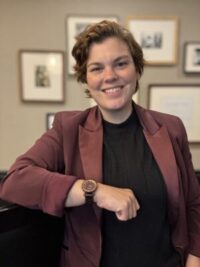
Jen St. Jude (they/them) is the author of If Tomorrow Doesn't Come and Where You'll Find Us. They live near Chicago with people (and an old dog) they love.