

The Circle Never Breaks: On Mister Magic, Childhood Horror, and the Stories That Know Us Before We Know Ourselves
There is a moment in Kiersten White’s Mister Magic that I have not been able to stop thinking about since I read it: A slow understanding of why five people, thirty years after a children’s program stopped airing, cannot fully account for what happened to them inside it. They came to the Circle of Friends as children because the people who were supposed to love them, protect them, nurture them had failed them. The Circle filled that absence. The magic was real. The love was real.
And the cost of it was real.
They cannot get those years back because they were not fully there to begin with. They were inside something that needed them to exist in a particular way, and that particular circumstance left no room for durable memory.
I know what it is to have lost time that way.
I grew up in a home where the people who were supposed to love me, protect me, nurture me failed at that, in ways significant enough that I ended up in foster care. Large portions of my childhood exist as feeling rather than image. You know the temperature of a room without being able to describe what was in it. IYKYK
Over time I have found myself drawn to a certain kind of story. I just kept finding it. The same thing kept showing up in the books and shows and films I loved most, and it took me a long time to understand why.
The story shape has a name, though I only learned it recently. Some people call it the Losers Club structure, after the group at the center of Stephen King’s It: seven misfit kids bonded by a shared supernatural trauma, scattered into adulthood, called back when the thing they defeated comes alive again. The mechanics vary across versions. Sometimes the memory is repressed and the return is a shock. Sometimes the survivors remember everything and have been living in the aftermath in plain sight, which is its own particular horror. Sometimes the group is chosen by prophecy, sometimes by circumstance, sometimes by whatever dark thing decided they were the ones worth keeping. What stays consistent: the bond formed in the shared terrible thing is the only bond that can face it again. The people you survived with are the only ones who know what you survived. And the past is never finished.
I have watched every adaptation of It. The 1990 miniseries with Tim Curry, which I watched at an age that was probably not wise (I was 6, yall), and the 2017 and 2019 films, which I have seen more times than I can count (it’s totally normal to have them be your comfort movie on a plane, right? Better than The Langoliers, I suppose). I have watched all of Stranger Things, a group of misfit kids who face something many of the adults around them can’t see or name, whose bond across seasons carries more emotional weight than most of what passes for adult drama on television. I have watched most of Mike Flanagan’s projects. The Haunting of Hill House takes the structure and makes it a family: siblings returning to a childhood home where the trauma is literally embedded in the walls, the past and present pressing against each other until one of them breaks. And Midnight Mass, an isolated community, a charismatic figure whose love is genuine and whose power is annihilating, the horror of a faith that asks you to disappear into it and calls that salvation. Kiersten has said she drew on her own religious upbringing in writing Mister Magic, and she has been careful to say the horror is not exclusive to that experience, that anyone raised inside a system that required them to surrender their interiority to belong will find themselves somewhere in these pages. She’s right. Midnight Mass and Mister Magic sit next to each other. Both of them hold simultaneously that the love was real and the harm was real. That those two things do not cancel each other out. That is a more accurate and more devastating thing to say about certain childhoods than most stories manage.
In books, I found the same pattern. Edgar Cantero’s Meddling Kids is the most direct and playful version I’ve read: a former group of child detectives, explicitly modeled on Scooby-Doo, who reunite in their mid-twenties to reopen the case that traumatized them as kids, only to find that the supernatural evil they dismissed was real all along. Edgar names the bones of the trope and builds something strange and funny and genuinely frightening on top of them. What held the group together as kids is the only thing that can hold them together now.
Veronica Roth’s Chosen Ones is one of my favorites because it inverts the usual mechanic. Her five heroes remember everything. They defeated the Dark One when they were teenagers, the world celebrated them, and then left them to manage the aftermath alone, with PTSD and addiction and fame as the evidence of what it cost. The horror is not that they forgot. The horror is that they remember perfectly and nobody else has to. When the threat returns, they don’t need to be called back. They never got to leave. Veronica is asking what it does to people to be chosen, and the answer is not kind.
Emily M. Danforth’s Plain Bad Heroines brings it into a queer lens and a dual timeline that spans over a century. A cursed girls’ school in 1902 where a secret society forms around a queer memoir and ends in death, and a present-day film crew that arrives to document the history and discovers the curse has opinions about visitors. The bond between its girls is a version of the trope’s emotional core: people who found each other inside a system that did not want them to.
What all of these share, and what Mister Magic does well, is the understanding that the group is not incidental. The group is the point. These are stories about what happens when the people who were supposed to show up for you don’t, and something else fills that space instead. Something that offers belonging on terms you don’t fully understand until it is too late. The bond that forms in that space is real. It is also the thing that marks you. You carry each other and you carry what made you need each other, and neither of those things goes away just because you grew up and moved on.
In most versions of this trope, the forgetting is a plot mechanism. The characters forgot because the horror was too large, and recovering the memory is how they defeat the threat. The forgetting is a problem to be solved. In Mister Magic, the forgetting is more complicated than that. The cast members cannot remember clearly because they were not fully there to remember. They were inside the Circle, inside the magic, inside something that held them and needed them and would not let them go even thirty years later. Kiersten is not writing about dramatic, cinematic trauma. She is writing about the quieter and more common experience of a childhood that required you to not quite be there in order to get through it. The cast members of Mister Magic are not haunted by what they remember. They are haunted by the shape of what they can’t.
I know that shape.
The circle doesn’t break just because you walked out of it. The people who were supposed to hold you and didn’t, the thing that filled that absence, the years you were somewhere else inside yourself in order to survive; none of that stays in the past just because you grew up and left. That is what this trope keeps trying to say, in every version, across every format. And that is what Mister Magic finally made me understand about why I have been finding it everywhere.
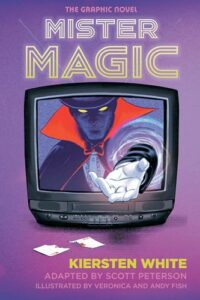
Mister Magic: The Graphic Novel
by Kiersten White, Scott E. Peterson, Veronica Fish, Andy Fish, Greg McKennaPublished by: Ten Speed Press
on June 9, 2026
Genres: Adult, Graphic Novel, Mystery, Thriller
Bookshop
Goodreads
NATIONAL BESTSELLER • Who is Mister Magic? Former child stars reunite to uncover the tragedy that ended their show—and discover the secret of its enigmatic host—in this “skin-crawling story of pop culture fandom and ‘90s nostalgia” (Melissa Albert, author of The Hazel Woods) from the author of Hide.
“[A] propulsive, exciting, often genuinely scary, endlessly compelling mystery.”—Terry Miles, author of Rabbits
A BEST BOOK OF THE PopSugar, Polygon, Chicago Public Library, CrimeReads
Thirty years after a tragic accident shut down production of the classic children’s program Mister Magic, the five surviving cast members have done their best to move on. But just as generations of cultishly devoted fans still cling to the lessons they learned from the show, the cast, known as the Circle of Friends, have spent their lives searching for the happiness they felt while they were on it. The friendship. The feeling of belonging. And the protection of Mister Magic.
But with no surviving video of the show, no evidence of who directed or produced it, and no records of who—or what—the beloved host actually was, memories are all the former Circle of Friends has.
Then a twist of fate brings the castmates back together at the remote desert filming compound that feels like it’s been waiting for them all this time. Even though they haven’t seen each other for years, they understand one another better than anyone has since.
After all, they’re the only ones who hold the secret of that circle, the mystery of the magic man in his infinitely black cape, and, maybe, the answers to what really happened on that deadly last day. But as the Circle of Friends reclaim parts of their past, they begin to Are they here by choice, or have they been lured into a trap?
Because magic never forgets the taste of your friendship. . . .
It’s Banned Books Week and we are featuring books by authors who have experienced censorship as well as other content related to censorship. Six of Kiersten’s previous titles have been challenged and/or censored due to satanic content () or being queer. If you’re looking for ways to fight censorship, we recently posted an interview with Dr. Alyssa Chrisman on ways you can help!







Leave a Reply