Feature: We Were Warned: YA Dystopian Fiction and the World We are Living in Now
There is a genre of book that an entire generation devoured in their yound adult years, stayed up too late finishing, and then set aside when they got older because the moment passed and so did they.
The moment did not pass. It was just getting started.
YA dystopian fiction had a run. Roughly 2006 to 2016, give or take, the shelves were packed with it. Totalitarian governments. Controlled information. Fractured societies. Disappearing middle classes. Young protagonists who figured out the system was rigged and refused to go quietly. We called it a trend. We marketed it as entertainment. We handed it to teenagers without thinking too hard about why those teenagers could not put it down, or what exactly they were recognizing in it.
Now those young adults are voters, tax payers, and looking at the world through a different lens. The books are still on the shelf. And a lot of us are picking them back up and feeling something close to vertigo.
Kelly recently described Feed by Mira Grant as a post-apocalyptic story about the importance of indie journalism that has never felt more realistic than in today’s world of book banning and mega-corporations owning and suppressing journalism. She is right. But Feed is not the only one. A whole shelf of books spent a decade warning us, and we filed them under genre fiction while the conditions they described quietly took root.
Mira Grant published Feed in 2010 (the book is old enough to drive, yall). In that world, traditional media collapsed in the wake of a zombie apocalypse and independent bloggers filled the vacuum, going where the cameras would not, telling the stories nobody else would touch. It sounds like a victory until you realize the corporations and the political machines still found ways to control the narrative, to make inconvenient truths disappear, and to make the people telling those truths disappear along with them. Today, local newsrooms are closing at a rate of more than two per week. Six corporations own the majority of what Americans read, watch, and hear. AI-generated content is flooding every platform faster than any fact-checker can keep up with. The independent voices are still out there, still fighting for it. The power working against them has just gotten more sophisticated and better funded.
Of course, Ray Bradbury got there first. Fahrenheit 451 predates the YA boom by decades but belongs in this conversation because he was not writing about a government that banned books by force. He was writing about a society that stopped wanting to read them. Discomfort got optimized away. Complexity became inconvenient. The books burned because people let them, because it was easier, because someone told them it was safer that way. That is a different and more honest kind of horror than jackboots and bonfires, and it lands differently now in an era of algorithmic feeds designed to keep you comfortable and school boards quietly pulling titles before the community notices they are gone.
The Giver was published in 1993 and has been challenged or banned more times than most people realize, which is its own kind of irony given what it is about. Lois Lowry built a Community that eliminated suffering by eliminating choice. A centralized authority decided what was too complicated, too painful, or too dangerous for ordinary people to sit with. Everyone was safe. Everyone was managed. Nobody could remember what had been lost because the memory had been assigned to a single keeper and placed out of reach. We are watching versions of that logic operate in real time right now, in library funding decisions, in curriculum fights, in the slow and quiet removal of books that ask hard questions about race, gender, history, and identity. The framing is always protection. It always has been.
Ally Condie pushed that further in Matched. The Society in that book does not just restrict information. It curates your entire existence, who you love, what you create, what you are allowed to want, and it does all of it through data and optimization and the premise that the algorithm knows better than you do what will make you thrive. The middle class does not collapse so much as it gets administered into irrelevance, sorted and processed until individual agency becomes indistinguishable from compliance. Reading Matched now, in an era of AI systems making hiring decisions and insurance determinations and shaping what millions of people see and click and believe, is a specific kind of uncomfortable.
Suzanne Collins built something different in The Hunger Games and its cultural staying power is not an accident. The Capitol consumed the labor and resources of twelve Districts to sustain its own excess. The people doing the most essential work had the least. Spectacle was weaponized to keep the Districts divided and pointed at each other instead of upward. The wealth gap in the United States is now wider than at any point since before the Great Depression. The top one percent holds more wealth than the entire middle class combined. The outrage cycles and the us-versus-them narratives that keep working people fighting each other while the extraction continues, Suzanne drew that map a long time ago.
Neal Shusterman showed up multiple on this shelf and he went somewhere most writers would not. Unwind built a world where bodily autonomy became an economic transaction, where the state and parents could choose to have a teenager harvested for parts under the legal fiction that no life was technically ended. He called it a compromise. He meant it as horror. In an era of ongoing fights over reproductive rights and healthcare access and who gets to make decisions about whose body, Unwind reads less like speculative fiction and more like a warning that arrived fifteen years too early. Scythe imagined a world where death itself had been conquered and a small selected group held absolute power over who lived and who did not, accountable to no one outside their own ranks and increasingly corrupted from within by people who had started to enjoy it. The parallels to concentrated power operating without external checks are not subtle and do not require much translation.
Veronica Roth’s Divergent sorted people into factions based on a single dominant trait and punished anyone who did not fit cleanly into the system’s preferred categories. The Factionless, those who could not or would not conform, were discarded. The sorting was never about serving people. It was about making them easier to manage. Marie Lu’s Legend built something similarly ruthless. The Republic’s Trial system was sold to citizens as a meritocracy, a path for the talented poor to earn their way up. It was actually a mechanism for identifying and eliminating the strongest potential threats before they could become problems. The cruelty was not incidental. It was the design. The people running it knew exactly what it was and kept running it anyway.
Cory Doctorow’s Little Brother is the one on this list that feels the least like metaphor. Published in 2008, it follows a teenager in a post-attack San Francisco where the Department of Homeland Security has turned surveillance infrastructure against ordinary citizens in the name of keeping them safe. Doctorow was writing about the post-9/11 moment. He was also writing about every moment after it in which safety has been used to justify the expansion of state and corporate power into private life. The book is eighteen years old. Its concerns have not aged a single day. If anything they have sharpened.
Here is what we keep coming back to: this genre was never really about the future. It was about teaching young readers to recognize the power of control before they were old enough to be fully inside it. The assumption baked into every one of these books was that naming a thing clearly, even in metaphor, even in a story about zombies or reaping ceremonies or memory keepers, was a form of preparation. That if you could see the structure in fiction you might recognize it in the real world before it closed around you completely.
Those books came out ten, fifteen, twenty, thirty years ago. The readers who grew up on them are adults now, watching information concentrate, choices narrow, resources flow upward, and power centralize faster than democratic institutions can respond. The vertigo is appropriate. The books were not wrong.
The question the genre always left its protagonists with was never whether the system was broken. It was whether knowing that was enough to make you look at the world differently.
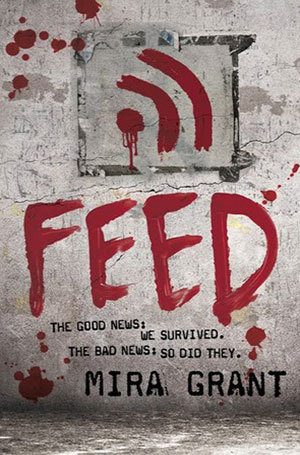
Feed (Newsflesh, #1)
by Mira Granton April 10, 2010
Bookshop
Goodreads
The year was 2014. We had cured cancer. We had beaten the common cold. But in doing so we created something new, something terrible that no one could stop.
The infection spread, virus blocks taking over bodies and minds with one, unstoppable command: FEED. Now, twenty years after the Rising, bloggers Georgia and Shaun Mason are on the trail of the biggest story of their lives—the dark conspiracy behind the infected.
The truth will get out, even if it kills them.